The Body Scientific
January 2024
Measles is Not Benign
Richard Kessin
He knows nothing and thinks he knows everything. That points clearly to a political career.
George Bernard Shaw in Major Barbara
In 1962, about 500,000 American kids got measles, with fever and spots made by the immune system reacting with the virus. Many of us remember it as relatively benign and I have heard people say, ‘I had it, and it wasn’t so bad’. But we are not all the same; some people respond differently; immune systems are complex and vary from one person to the next. About 20% of affected children had complications from measles, usually encephalitis, an inflammation of the brain. Or they had diarrhea and dehydration. Many were hospitalized and about four hundred died. Year after year. That is hard to imagine now, because in 1963, a vaccine was produced by the legendary Dr. Sidney Hillman and his team at Merck. The Merck team made many vaccines and saved millions of lives.
After 1963, measles was one less thing for parents to worry about, along with polio, mumps, rubella, and then chickenpox. Whooping cough, diphtheria, and tetanus had been dealt with through earlier vaccines. Measles virus did not disappear, it was not eradicated like smallpox; It stalks unvaccinated communities.
The measles virus is very contagious, more than SARS-CoV-2. Measles has another insidious property—it wrecks existing immune responses and not just a person’s response to measles. Imagine a child in Africa, whose immune system is just managing to keep the malaria parasite at bay. A case of measles will depress the child’s immune system, and unleash the malaria parasite, which may kill the child. Measles virus is one of the great killers in Africa with 47,000 deaths in 2022. Most viruses have ways to suppress immune systems, but measles is a champion of immune suppression and contagion.
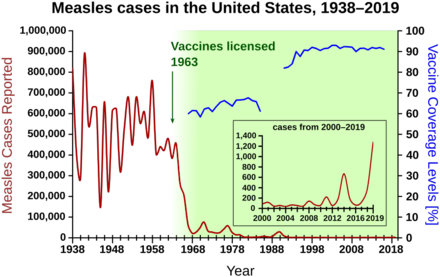
The vaccine is exceptionally effective as the graph shows. The graph also shows that measles returns when vaccination stops. In an under-vaccinated community, a single tourist shedding measles virus can start an epidemic. That is what happened in September 2019, in American Samoa, in the months before the Covid pandemic.
The ground had been prepared by Robert F. Kennedy Jr., who had visited Western Samoa, met with government officials, and told them and other people that the vaccine caused autism. In 2017, 74% of babies were vaccinated, which was already low, but by January 6, 2020, only 31-34% of newborns were being vaccinated. Before the outbreak there were almost no cases of measles . A single infected tourist introduced the virus and by the 6th of January 2020 there were 5,700 cases and 83 deaths. The population is about 200,000 and many thousands of doses of vaccine (measles, mumps and rubella) were administered. Schools were closed, and sports teams were idle (Samoans play rugby). People stayed home and hung out a red flag to summon the vaccination teams. Other islands in the region had 99% vaccination rates and no measles or increases in autism.
An emergency response by Samoan health workers converted to vaccinators with help from CDC and the public health agencies of New Zealand, Australia, Israel, and Franch Polynesia and many other countries, stamped out the measles epidemic by January 22, 2020.
I do not know if there were any cases of autism among the thousands of children who were vaccinated, as Mr. Kennedy’s theory predicts. Did Mr. Kennedy even ask If autism had increased after thousands of kids got measles vaccine? There should have been a wave, according to his theory, but if you don’t ask, the theory remains intact.
The American Samoa Public Health website does not mention autism as a problem. I called the Samoan Health Authorities to be sure. They were very cooperative and have not noticed anything of concern, but being competent officials said that they would do a deeper investigation if they got a request from a higher authority. That would be Mr. Kennedy.
The message from these events is simple: Be skeptical of people who never admit that they are wrong. Do not trust people whose message is meant to instill fear. Don’t believe people who think they know, but don’t. Do not put Robert F. Kennedy in charge of any American health agency, let alone all of them. For that, alas, we are too late.